S.A.C. |
Space for Art & Culture
Openingstijden
do, vr en zat van 12.00 uur tot 17.00 uur
Looptijd expositie van 9 maart tot en met 20 maart.
Activiteit
Expositie
Zi Xun Dang
Through my work, I explore attachment, loss and the process of being adopted, reflecting on the complexity of identity and belonging. My practice asks questions without answers. Through the theme of adoption and being adopted, I try to visually express the complex emotions and intimate questions this topic evokes, using found and discarded materials to recreate what is needed.
Due to my adoption, I experienced a sense of rootlessness and a loss of history, which made it difficult to feel at home. At the same time, this experience has also caused me to consciously feel at home anywhere. In China, I am a Dutch Chinese and in the Netherlands, I am a Chinese Dutch. Being an orphan, and in that sense rootless, has developed into both an opportunity and a particular way of looking at the material world and my work. I adapt myself to other places with a heightened awareness of my surroundings. For me, there is an innate urge to create a sense of home wherever I am. This feeling arises from the necessity of reflecting on moving, losing, finding and being found. A sense of home becomes a balance between longing for safety, stability, acceptance and the experience of having a home and not having one.
Over the past years, I have become fascinated with Arte Povera, Land Art and Object-Oriented Ontology, particularly their use of lost or discarded materials. I have also recently developed a strong interest in the work of Francis Alÿs, Bill Viola and Sara van der Heide. Creating and curating works with lost or discarded materials in different places has become a way of adopting these materials and recreating their histories. Materials, like people, carry stories; through care and attention, they can adopt us back, forming bonds of trust, memory and care.
Through my work, I explore attachment, loss and the process of being adopted, reflecting on the complexity of identity and belonging. My practice asks questions without answers: What do we adopt and what adopts us? How can care, attention and presence transform what is lost into something that feels like home? What is the difference between identity and identify, adopt and adapt? Through the theme of adoption and being adopted, I try to visually express the complex emotions and intimate questions this topic evokes, using found and discarded materials to recreate what is needed.
Valentino Baudis
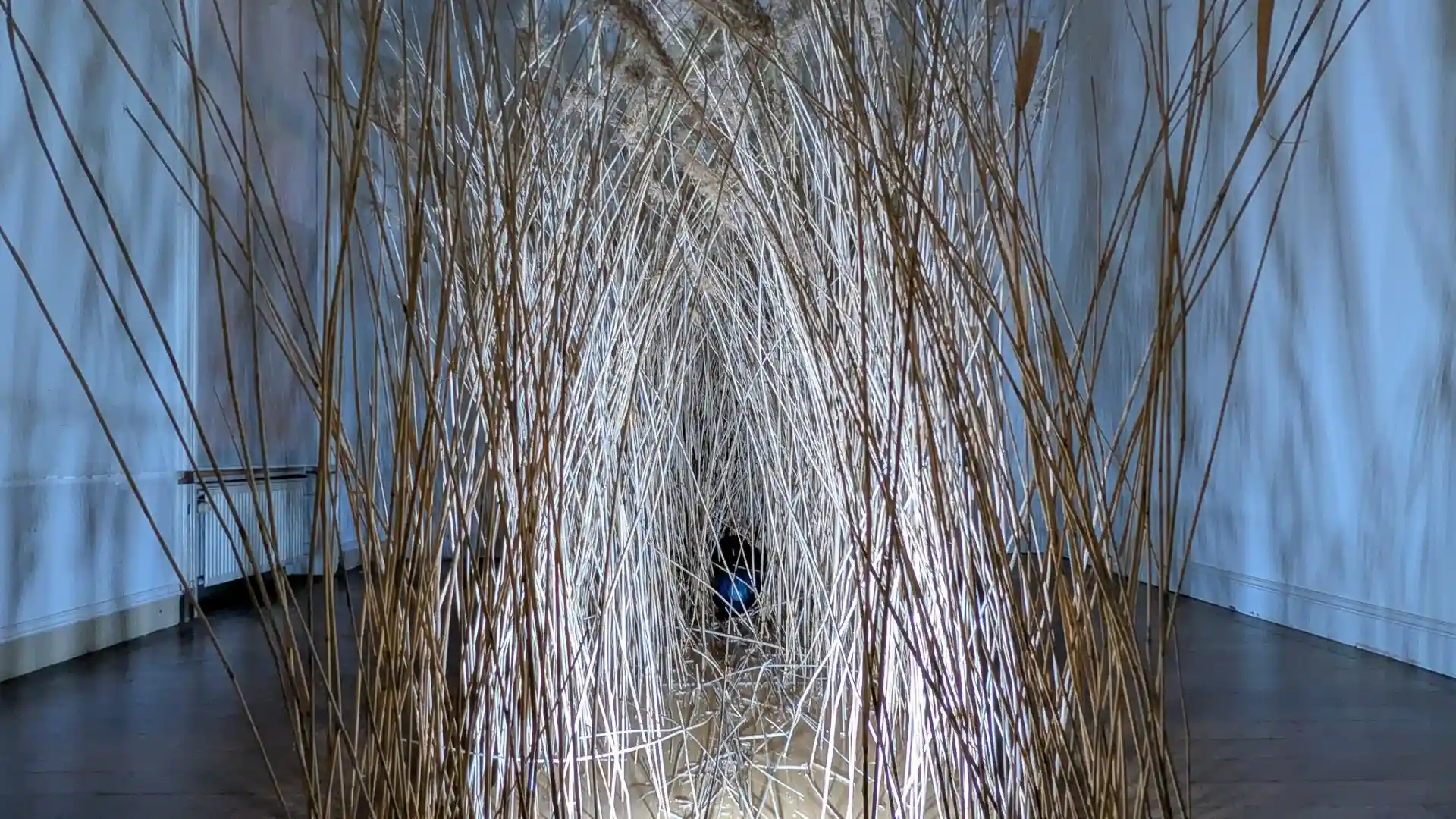
Valentino Baudis (b. 2001) is a Munich-based German artist whose practice focuses on sculpture and installation. Working with discarded functional materials and organic growth elements, he investigates how systems of utility, repetition, and stability shift when removed from their original contexts.
Grounded in direct engagement with his immediate surroundings, Baudis collects, arranges, and repositions materials from cultivated and infrastructural landscapes to explore evolving relationships between engineered structures and ecological temporality.
Valentino Baudis engages with discarded functional materials sourced from the threshold between cultivated farmland and constructed infrastructure on the outskirts of Munich. He is drawn to objects that have served a precise purpose and investigates what remains once their original system of use has dissolved.
In his work, engineered remnants encounter organic growth elements such as common reed. Industrial components embody repetition, engineered stability, and single-purpose design; organic materials introduce adaptive growth logic and seasonal temporality. Their structural interdependence produces a tension between fixed utility and evolving form.
Through collecting, arranging, and balancing, Baudis constructs sculptural bodies—entities that suggest reassigned functionality without fully resolving it. The work operates as a proposal, testing how structures designed for controlled use might be reactivated within a broader ecological timeframe, foregrounding the human impulse to stabilise and instrumentalise space.